
Every farm has its own way of getting the job done. Equipment, acres, crop mix, labor and fertilizer practices all factor into how a grower approaches tillage and nutrient application. This means there is no one-size-fits-all answer when it comes to investing in a new tillage and fertilizer system. When making a change in machinery, growers need to understand how a system will fit into their existing operation and, just as importantly, what it could cost to run. That’s where a side-by-side comparison can help.
To do this, we’ll compare two operation cost scenarios on the same 3,000-acre operation using a 50/50 corn and soybean rotation:
- First, the grower runs a SoilWarrior® 4540SED XX2 16-row dry dual-bin configuration that combines tillage and fertilizer application into one pass.
- Second, the grower runs a conventional tillage operation. In this conventional system, the grower uses a ripper, field cultivator and fertilizer spreader to prepare the field and apply nutrients.
- The same 500 hp tractor will be used in both scenarios.
- This is an operational cost comparison; the new equipment purchase cost is comparable (SoilWarrior vs. ripper, cultivator and fertilizer spreader), with the SoilWarrior slightly lower in cost.
Using the same large tractor for both scenarios and conservative operating assumptions of $100 per tractor hour and $5.50 per gallon for diesel, the difference in operating costs can add up quickly. Note that these cost analyses focus only on operational costs and do not account for other variables associated with crop production.
Breaking Down the Numbers
For the SoilWarrior scenario, the 4540SED XX2 is assumed to cover 35 acres per hour across 3,000 acres. That equates to approximately 85 hours of field operation and 2,150 gallons of diesel. At $100 per tractor hour, the tractor operating cost is approximately $8,500. At $5.50 per gallon, fuel adds another $11,825. For the SoilWarrior, the annual operating cost is $20,325.
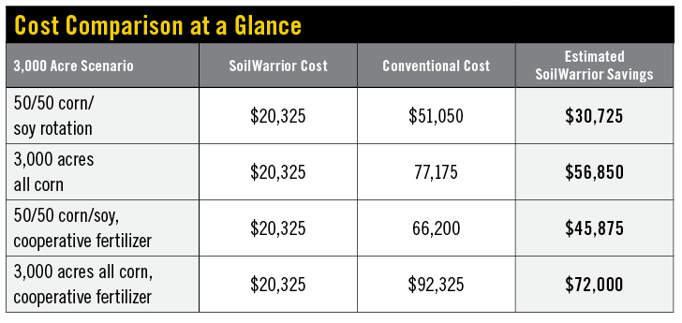
Now compare that with a conventional tillage and fertilizer system on the same 3,000-acre, 50/50 corn and soybean operation. The ripper covers 1,500 acres at 14 acres per hour, followed by a field cultivator across all 3,000 acres and a fertilizer spreader across the full farm. Together, those operations require approximately 230 tractor hours and 5,100 gallons of diesel. That puts the estimated tractor cost at $23,000 and fuel at $28,050, putting the total annual operating cost at $51,050.
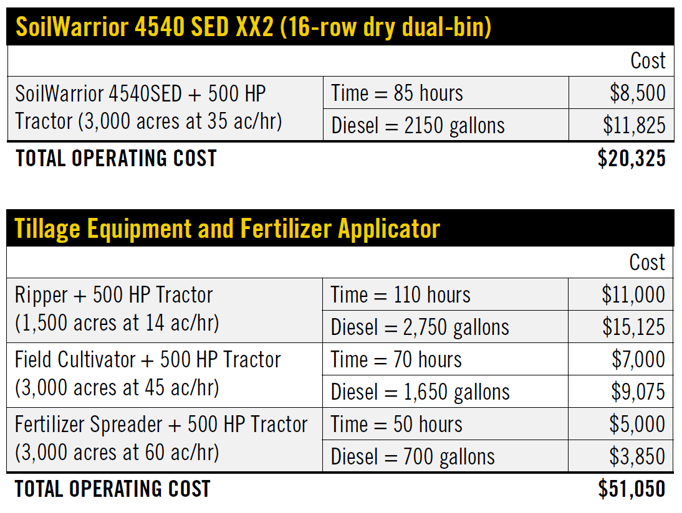
Total SoilWarrior Savings: $30,725
In this scenario, the SoilWarrior system reduces the estimated equipment and operating cost by $30,725, or approximately $10.24 per acre across 3,000 acres. And that’s before considering any potential fertilizer savings.
What if the Entire Farm is Corn?
Crop mix can change how a tillage system is used. On a 3,000-acre farm planted entirely to corn, the conventional system requires ripping all 3,000 acres, rather than 1,500. That adds significant time and fuel to the conventional system.
The ripper alone requires approximately 220 hours and 5,500 gallons of diesel. Add the field cultivator and fertilizer application, and the conventional system totals approximately 340 tractor hours and 7,850 gallons of fuel.
At the same $100-per-hour tractor cost and $5.50-per-gallon diesel assumption, that comes to approximately $34,000 in tractor costs and $43,175 in fuel. Total conventional tillage equipment and operating cost: $77,175.
The SoilWarrior 4540 SED remains at approximately $20,325 for the 3,000-acre application. That creates an estimated SoilWarrior advantage of $56,850, or approximately $18.95 per acre.
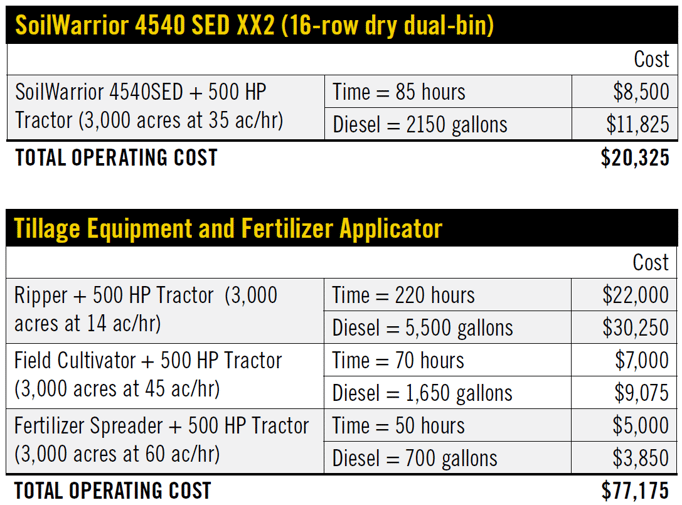
Total SoilWarrior Savings: $56,850
The difference illustrates an important point: the economics of a tillage and fertilizer system can change depending on how many acres require each operation.
What if Fertilizer Application is Outsourced?
Not every operation owns its own fertilizer spreader. Some growers rely on a cooperative or custom applicator to handle fertilizer application. That changes the comparison, but it doesn't necessarily eliminate the advantage of combining operations.
Consider our original 3,000-acre farm with a 50/50 corn and soybean rotation. In this scenario, the grower still uses a ripper on 1,500 acres and a field cultivator on all 3,000 acres, but fertilizer is applied by the cooperative at an assumed cost of $8 per acre.
The conventional system requires approximately 180 tractor hours and 4,400 gallons of diesel. The tractor cost is approximately $18,000, fuel is approximately $24,200 and the cooperative fertilizer application adds $24,000. Total estimated cost is $66,200.
The SoilWarrior scenario remains at approximately $20,325. That creates an estimated SoilWarrior advantage of $45,875, or approximately $15.29 per acre. In other words, even when fertilizer application is outsourced, combining tillage and fertilizer application into one operation can significantly change the operating-cost equation.
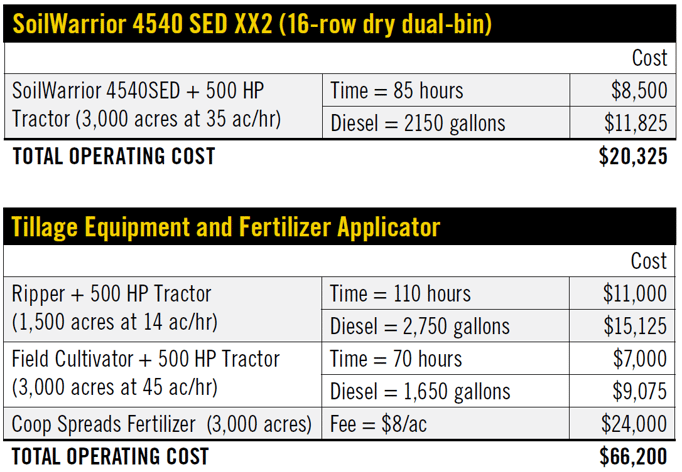
Total SoilWarrior Savings: $45,875
And if the Entire Farm is Corn?
The difference becomes even larger when all 3,000 acres require the more intensive tillage program. Under the conventional system, running the ripper and field cultivator over all 3,000 acres requires approximately 290 hours and 7,150 gallons of diesel.
At the assumptions used in this comparison, that's approximately $29,000 in tractor costs, $39,325 in fuel and $24,000 for cooperative fertilizer application. Total estimated cost becomes $92,325.
Compared with the SoilWarrior system at approximately $20,325, the estimated difference is $72,000. That's approximately $24.00 per acre across the 3,000-acre operation.
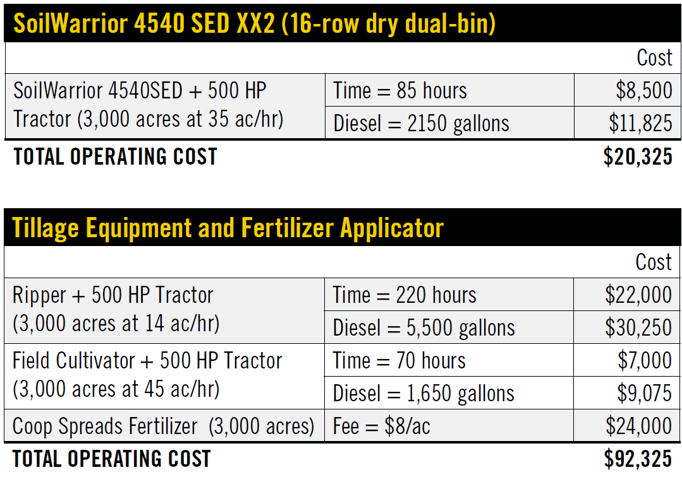
Total SoilWarrior Savings: $72,000
The Investment is About More Than the Equipment
A new tillage and fertilizer system is a significant investment, so the right question isn't simply, "What does the machine cost?" The better question is, "What does it cost me to operate my current system and what could change if I did things differently?"
The scenarios above demonstrate how quickly tractor hours, fuel use and custom application costs can add up when multiple field operations are required.
The SoilWarrior 4540 SED XX2 can combine tillage and fertilizer application into one pass, potentially reducing the number of trips across the field while lowering associated equipment and operating costs. For the 3,000-acre scenarios shown here, the estimated equipment and operating-cost advantage ranges from $30,725 to $72,000, depending on crop mix and whether fertilizer is applied in-house or by a cooperative or other custom applicator.
And there may be another piece of the equation.
These comparisons intentionally do not account for potential fertilizer savings. Because the SoilWarrior system places fertilizer during the tillage pass, growers may have opportunities to rethink nutrient placement, application efficiency and fertilizer rates based on their individual agronomic program. Those potential savings would be in addition to the equipment and operating-cost differences outlined here.
Ultimately, every farm has a different starting point. The best way to understand the SoilWarrior advantage is to put your own acres, equipment, operating costs and fertilizer program into the equation. Because making the right investment starts with understanding what your current system is really costing you.
To learn more about the costs of owning a SoilWarrior visit this link or start the conversation with our SoilWarrior team here.
Cost comparisons are based on the assumptions outlined above and are intended as examples. Actual costs will vary by operation, equipment, field conditions, fuel prices, custom application rates and other factors. These comparisons account for equipment and operational costs only and do not include potential fertilizer savings.
Watch the SoilWarrior in Action


.png?width=48&height=48&name=twitter%20(4).png)



Comment